Though not all tattoos hurt equally; all tattoos hurt. While areas such as the forearm, upper arm, and parts of the legs are largely considered tolerable in terms of pain, other areas such as the throat, ribs, and chest, have a reputation for being particularly difficult to withstand. Despite the pain and difficulty, tattooing in these areas is still common. In addition to the pain experienced from the client in tattooing the respective area, it is often the case that the same areas can be difficult to tattoo by the tattooist on a material level, due to factors such as skin elasticity and body shape, which can affect the ease of needle insertion. A lesser discussed, but commonly experienced difficulty in tattooing painful areas from the perspective of the tattooist, are the contentions with compassion for the person who is receiving the tattoo; navigating the burden of responsibility in being professionally required to perform a service in which intense pain is an unavoidable, in order to achieve the desired outcome.
This autoethnographic account of tattooing a large-scale tattoo on the chest covering an existing unsatisfactory tattoo elucidates on the multiplicity of non-material factors that shape and inform the role of the tattooist. The account illustrates aspects of the tattooing experience, from consultation and design process, through to tattooing procedure, using the self as a vehicle through which the experience of performing a painful tattoo can be understood on a more generalisable level. The cultivation of compassion for clients, and struggles with the necessity of pain infliction upon them are discussed, and reflections made upon the tensions this can cause for the practitioner. The interactions between the material and the non-material nature of practice are confessionally exposed, in an attempt to reveal, and thus better understand, the nuances and richness that exist in the role of a contemporary western tattooist.
This autoethnographic account of tattooing a large-scale tattoo on the chest covering an existing unsatisfactory tattoo elucidates on the multiplicity of non-material factors that shape and inform the role of the tattooist. The account illustrates aspects of the tattooing experience, from consultation and design process, through to tattooing procedure, using the self as a vehicle through which the experience of performing a painful tattoo can be understood on a more generalisable level. The cultivation of compassion for clients, and struggles with the necessity of pain infliction upon them are discussed, and reflections made upon the tensions this can cause for the practitioner. The interactions between the material and the non-material nature of practice are confessionally exposed, in an attempt to reveal, and thus better understand, the nuances and richness that exist in the role of a contemporary western tattooist.
Kacper
(Names changed for confidentiality purposes)
Kacper had come into the studio on a day in which I wasn’t working prior to our meeting, and was suggested to book in with me for the tattoo style he wanted. He had returned on a day on which he was informed I’d be around, and asked the desk staff to speak to me to find out if I was happy to produce the tattoo he desired. As I was summoned to towards the desk to arrange a booking, I recognised the person who Kacper was with as Maček; an existing client of another tattooist working in the studio. I greeted both Maček and Kacper, and asked how I could help. Maček and Kacper are of Polish origin, and while Maček is fluent in English, Kacper could communicate sufficiently for basic interactions, but was less able to speak as fluently as Maček. Maček had introduced Kacper to the studio as a reputable place to get a tattoo, and accompanied him to assist in making the booking and translating any information that was beyond Kacpers understanding.
Kacper explained to me that his English is limited, and that Maček would communicate for him for the most part. Maček showed me an image of a tattoo on a phone screen of a tattoo. The tattoo was on the chest area, in black ink exclusively, and in a ‘sketchy’ style. The style shared commonalities with my own, which is why I was suggested as the tattooist. The subject matter was a pair of wings that went down onto the chest area, with the words ‘fuck alcohol’ incorporated into the design. It was explained that the text was not wanted, but the subject matter and something similar in style where desired. The explanation process was a combination of direct communication with Kacper, and occasionally Maček would interpret what I was saying, to which Kacper would respond, and Maček translate back to me. I tried at all times to communicate to both Maček and Kacper, through direction of my eye gaze and bodily positioning towards both of them.
Kacper explained that he would also like an existing tattoo that he has to be covered, which he pulled down the collar of his t-shirt to reveal to me. The tattoo was underneath his right collarbone, and was text that read ’15.05.1973 – 16.07.2003’. It was explained to me that this date was incorrect, and that the text should have read ‘14.05.1973 – 16.07.2003’. The significance of the date was not revealed, assumingly as it was not directly relevant to the line of inquiry Kacper was making, however Maček explained to me it was desired to have date incorporated into the piece in another way. I suggested that we could incorporate it into the piece and have the text be in a similar style to the tattoo, rather than similar to Kacpers existing style of text tattoo. Kacper expressed enthusiasm with this idea, or at least I interpreted his wide eyes and agreeable disposition as enthusiasm. I also explained that we wouldn’t be able to fully cover the exisiting tattoo due to the negative space that would be in his requested design, but we could obscure it from being obvious. Kacper said that he understood, and his body language / response suggested to me that he had anticipated that would be the case anyway.
(Names changed for confidentiality purposes)
Kacper had come into the studio on a day in which I wasn’t working prior to our meeting, and was suggested to book in with me for the tattoo style he wanted. He had returned on a day on which he was informed I’d be around, and asked the desk staff to speak to me to find out if I was happy to produce the tattoo he desired. As I was summoned to towards the desk to arrange a booking, I recognised the person who Kacper was with as Maček; an existing client of another tattooist working in the studio. I greeted both Maček and Kacper, and asked how I could help. Maček and Kacper are of Polish origin, and while Maček is fluent in English, Kacper could communicate sufficiently for basic interactions, but was less able to speak as fluently as Maček. Maček had introduced Kacper to the studio as a reputable place to get a tattoo, and accompanied him to assist in making the booking and translating any information that was beyond Kacpers understanding.
Kacper explained to me that his English is limited, and that Maček would communicate for him for the most part. Maček showed me an image of a tattoo on a phone screen of a tattoo. The tattoo was on the chest area, in black ink exclusively, and in a ‘sketchy’ style. The style shared commonalities with my own, which is why I was suggested as the tattooist. The subject matter was a pair of wings that went down onto the chest area, with the words ‘fuck alcohol’ incorporated into the design. It was explained that the text was not wanted, but the subject matter and something similar in style where desired. The explanation process was a combination of direct communication with Kacper, and occasionally Maček would interpret what I was saying, to which Kacper would respond, and Maček translate back to me. I tried at all times to communicate to both Maček and Kacper, through direction of my eye gaze and bodily positioning towards both of them.
Kacper explained that he would also like an existing tattoo that he has to be covered, which he pulled down the collar of his t-shirt to reveal to me. The tattoo was underneath his right collarbone, and was text that read ’15.05.1973 – 16.07.2003’. It was explained to me that this date was incorrect, and that the text should have read ‘14.05.1973 – 16.07.2003’. The significance of the date was not revealed, assumingly as it was not directly relevant to the line of inquiry Kacper was making, however Maček explained to me it was desired to have date incorporated into the piece in another way. I suggested that we could incorporate it into the piece and have the text be in a similar style to the tattoo, rather than similar to Kacpers existing style of text tattoo. Kacper expressed enthusiasm with this idea, or at least I interpreted his wide eyes and agreeable disposition as enthusiasm. I also explained that we wouldn’t be able to fully cover the exisiting tattoo due to the negative space that would be in his requested design, but we could obscure it from being obvious. Kacper said that he understood, and his body language / response suggested to me that he had anticipated that would be the case anyway.
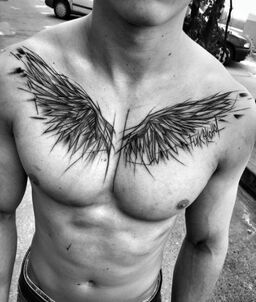
Image reference for Kacpers tattoo, by tattooist, Inez Janiak. Image source: pinterest.com
I advised that the tattoo would take multiple sittings, and warned that the area of the body is particularly painful. I made a particular effort to clarify Kacper understood this by repeating it a few times, as he was keen on sitting for a full day for the first session at the set discounted rate of £250, which is still required if the client chooses the end the session early. This is a system set by many studios, as the tattooist Is often unable to find a client should the client they are booked to tattoo for a full day end the session early, and thus potential earnings are lost. I explained that we would tattoo as much as possible in the day, and book another session to finish it off based on how many hours are forecast. I suggested a total capped cost of the tattoo at £360; this was a maximum price, and stated to allow sufficient time to complete the tattoo to a high quality, with the understanding that it would likely take less time than the price suggests and thus be priced accordingly. Kacper and Maček appeared to both be happy with all that was discussed. After finding a suitable date to complete the tattoo, I requested a £100 non-refundable deposit to secure the time slot. This is common practice within many studios, and prevents any loss from having spent time on designs for clients that don’t end up being tattooed due to the client absence.
After signing a form stating that he agreed with all the terms outlined, and Maček translating the terms when necessary, Kacper handed me a handful of £20 notes. I can’t recall the specific value, but I noticed that there was far more than £100 which is all I needed to take from him, so I politely returned the excess, attempting to light-heartedly explain that he didn’t need to leave as great a deposit as he handed over in a such a way that would not embarrass him. I noticed that Kacper had no other visible tattoos other than what he had shown me, and considered that he was likely nervous on 2 accounts; the first being organising an experience that was both unfamiliar, painful, and potentially emotionally evocative, and the second being that he is in an environment in which he could not fluently communicate in a culture different to what he was used to. I felt a strong desire to ensure that he was comfortable and understood everything I had said, which I had to contend with while also not patronising him by over explaining myself.
After securing the appointment and writing the details on an appointment card, I asked that Kacper email me the reference image, and the text that he would like added to the design, for me to prepare in advance of his appointment. A few days later, I received an email with all of the relevant information, from which I prepared the design. As the design was of 2 wings, I sourced various images of birds such as eagles with fully spread wings, and put them onto photoshop together as a reference sheet, alongside the tattoo that was shown to me as a source image. This sheet was then printed at a4 size, and used as a series of reference images to create a pencil sketch of a wing in a style that was similar enough to Kacpers desired style, but distinct enough to not be plagiarised.
It was considered that only one wing would be necessary to draw as the design could be replicated and flipped, with deviations being made from the stencil in the actual tattooing procedure. This pencil sketch was then traced with a calligraphy-nibbed fine liner and tracing paper, before being scanned and placed into Adobe Photoshop, where it was flipped and edited slightly to make it not 100% symmetrical and appear more natural. The finished wing design composite was then printed, and text drawn in a similar style to the image added in pencil onto the print out. This was then traced in a similar fashion to the above, before an alternative text option was also created. This was to give Kacper more options in his design choice. Both texts where scanned into the computer and placed into the file containing the wing design, and 3 variations of placement where created.
On the appointment day, Kacper arrived alone, without Maček, who he told me was working that day. After he had completed a consent form, I showed Kacper the design options, from which he selected the version I personally favoured also. I printed the design at various sizes, and asked Kacper to follow me up the stairs where we could asses what size was the best fit for his chest. In most circumstances, the sizing process is completed while the client is in the waiting area, but as in this case it would require Kacper to remove his t-shirt, I thought it more respectful to allow him more privacy. As we walked up the stairs, Kacper reminded me in an almost apologetic tone that his English was limited. I assured him that it was not a problem, and that as long as he could inform me if he needed to stop at any point and let me know he was OK, then there were no issues. While shaving Kacpers chest and applying the stencil, I found that Kacpers English was far better than he seemed to believe, as we were able to engage in general small-talk. Prior to his appointment, I was anxious that I would struggle with applying the stencil and having it cover up Kacpers existing tattoo effectively, but I didn’t want to communicate this to him in fear of appearing inept.
Kacper explained to me that he was from Gdansk in Poland, and had been in the UK for 6 months working in IT. While chatting with clients, I often hope to connect in some way and share something about myself as a means of making them more comfortable and the space more open, and so I told Kacper that I had a good friend who was from Gdansk, who had taught me some basic phrases. Kacper appeared to be very surprised and delighted by this, which was expressed through his laughter, as I (no doubt badly) spoke the 3 phrases that I could recall. The laughter was loud in such a way that suggested more of the release of tension in an uncomfortable sitaution, more so than the expression of humour. Kacper translated each one into English after I said it, and appeared more comfortable immediately after such an exchange. I couldn’t explain in logical terms the reason why, but I couldn’t help but immediately like and care for Kacper, in a similar fashion to how I might for a younger brother, despite the age gap not being particularly wide. Perhaps the delta between cultural contexts made me perceive Kacper as more vulnerable than he actually was, and I felt compelled to try to connect with him.
As the stencil dried, I asked Kacper if he had eaten anything in preparation for the appointment as advised. He told he had eaten four sandwiches, holding up four of his fingers while doing so, and laughing in the acknowledgement that this was a healthy sized breakfast in preparation for the tattooing. He then pointed to the printed design, and explained that the date on the design was the date of his mother’s birth and death. I told him that I was sorry to hear of his loss, and he convincingly assured me that it was OK; it was convincing in that his eyes did not seem to indicate any shift in emotion in the topic being introduced from when we were discussing sandwiches, however it was apparent it was still significant to him, or no date would be necessary to add to the design he was getting tattooed. The recognition of the memorial nature of the tattoo, alongside the compassion and empathy I already felt towards Kacper as a Polish person living in a city that has historically not been very tolerant of those from outside of even its region, never mind country, made me feel additionally responsible to ensuring a positive experience for Kacper.
After setting up the basic materials and finding a suitable position for the tattooing procedure, in which I could ensure a tight stretch of the skin, and Kacper could stay still for a prolonged period of time, the tattooing procedure began. This started with the right-hand side of the tattoo which was where the existing tattoo was already, with the decision for doing so being based on the importance of getting the cover-up side correct more so than the non-tattooed side, and the recognition that the stencil will inevitably fade as the procedure continues making the accuracy to printed design increasingly more difficult. After creating the first line of the tattoo, I could sense Kacpers discomfort in the tension of his body and rigidity of posture. I offered him some kitchen roll to have in his hands, to reduce the sweat that was naturally coming from his palms. I asked if he was OK, and he insisted he was fine. At this point, he was not moving frequently as can often be the case when a client is in pain, and he sat very well. Kacper asked me when he could next go to the gym, and I asked if he trained with weights, or cardio. With a straight face and matter-of-fact tone, he expressed ‘cardio, because I am fat’, which I didn’t feel was particularly true, and felt a sadness in that Kacper saw himself this way and stated so in such a objective manner. His expression of disdain towards his body image reminded me of myself and my life-long issues with bodyweight and eating disorders, and of younger brother who has similar issues. I felt I wanted to make peace with his insecurity in the way I am unable to do for myself, but I recognised that this was not appropriate. I told him that cardio was fine, but to avoid weights as stretching the areas close to the tattoo may irritate it and interrupt the healing.
Tattooing Kacper was my first time tattooing a chest, and I found that I had to adjust from seated to standing at various points to create a sufficient stretch of the skin. In doing so, I found myself in unnatural positions that made me feel very physically uncomfortable, but where necessary to ensure the line quality that was required. I found this particularly stressful, as in addition to the physical pain I was causing Kacper, I was also experiencing my own pain, and found that the stencil was fading due to the natural sweating of Kacper through the painful procedure. At this point, I committed to tattooing the most crucial lines to ensure the design was rendered in its intended shape, valuing the more gestural shading lines lesser in specificity of replication from the printed design than the core shape of the wing. I also ensured that I tattooed the date of death before the stencil faded, given the significance of this part of the tattoo.
After completing the first part of the basic shape of the right-hand side of the tattoo, I asked Kacper to stand off the massage bed, and lay down on the opposite side of it so I could tattoo the left side of his body. The same procedure was followed, with slightly more confidence from having undertaken tattooing the right-hand side, but also exhaustion in having done so. Kacpers breathing was becoming increasingly unsteady as the tattooing procedure commenced, and when I occasionally looked at his face I noticed that he was squinting. I asked at regular intervals if he was OK, which he assured me was, and I insisted that I get him a drink of water as I noticed a white deposit around the corners of his mouth and I worried that he may be dehydrated. After completing the second outlining stage of the tattoo, I suggested that we take a lunch break as it was around 1pm, and the session was set to end at 5pm. After cleaning it with green soap (a combination of witch hazel and aloe vera antiseptic soap) I wrapped Kacpers tattoo in cling film, and asked him if 25 minutes would be a sufficient lunch break. I told him he could have longer if he liked, however he stated that 25 minutes was fine as he had prepared more sandwiches.
As there is no food allowed in the tattooing areas, I asked Kacper if he could eat in the waiting area. The morning of the appointment I had had an argument with my partner, which by the time I arrived at work was resolved, however in my distraction I had forgot my lunch. I left the studio to get some lunch, and on my return noticed a few of my colleagues outside the studio smoking cigarettes and chatting, while Kacper was stood alone with his vaporiser pen, looking down at his phone. As a non-smoker, I felt that I wanted to ask my colleagues to attempt to engage with him, but I considered how it was not appropriate or reasonable, or possibly necessary to do so, and how if I were in the equivalent scenario I would likely prefer to be alone. Despite this consideration, i couldn’t help but feel that I wanted Kacper to not be isolated. I ate my lunch and had a 1-cup French press of coffee brewing while I did so. Kacper returned inside of the studio, and took a seat on the couch a little further away while typing on his phone. After finishing my salad, I pressed the coffee, and with the French press in hand to indicate what I was asking visually, I approached Kacper and asked if he would like to have half of my coffee. He took a moment, before saying that he would, and I handed him half a paper cup of black coffee, pointing out where the milk and sugar was kept should he need any. After cleaning the press, I invited Kacper back upstairs to commence with the tattooing.
The remainder of the tattoo involved relining areas, saturating the lines to create a varied line weight, and adding a heavy amount of detail to suggest feathers. I asked Kacper if he could position himself the way in which we started, suggesting that we would start with the right-hand side first. I removed the cling film from Kacper that was wrapped around his shoulders and chest, wiped down the bodily fluids that had naturally occurred in the time that the tattoo was wrapped, and began the tattooing process. As I made the first mark, I noticed a much more severe and obvious sense of discomfort from Kacper. I tried to continue with conversation, and asked Kacper what sandwich filling he had, to which he told me was a combination of "cheese, ham, and ketchup...but Polish ketchup!" - he expressed this with pride and enthuisiasm, pointing as he did so to indicate the distinction from British ketchup. Despite the enthusiasm, I could see he was in a lot of pain, and choose not to pursue conversation in fear of being an additional irritant to the needles I was inserting into his already traumatised skin. As i tattooed, i noticed that the pigment was not appearing to go into his skin at a dark enough saturation. I questioned multiple parts of my practice. I stopped to refill my ink pots with black ink despite them being over half-way filled, in the assumption that the frequent moving from the body to the ink caps of the needle may have resulted in watering the ink in the pot down with the blood that was on the needle. This was not sufficient, and the lines where still not going into the skin as I required them to.
I adjusted my needle cartridge, thinking that perhaps there where faults with the cartridge I was using, but this did not appear to be the case. I adjusted the voltage that the machine was running at, sweating and feeling flustered while doing so, worrying that the voltage could be high enough to be risky and contemplating my options. When this didn’t seem successful, I switched to a more familiar machine, thinking that perhaps the ‘drive bar’ that makes the needle go in and out was not machine was not sufficiently engaging. While this helped to some extent, I still found that every line I produced was causing a lot of bleeding and evidently a lot of pain to Kacper, but not delivering the results. I attempted adjusting how I had Kacper positioned, and in what was no doubt apparent, adapted my own standing/seating position in numerous ways in a very flustered fashion. I did not vocalise any of my concerns, however my body temperature, redness of tone, and constant adjustment no doubt communicated my distress more lucidly than any vocal expression would be able to.
After much frustration, the tattooing began to go the way that I needed it to more so than it had previously. As I glanced up at Kacper, I noticed how much pain he was in, which was evident with all of the movement he was making with his hands, feet, and legs. I continued to ask him if he was OK or if he wanted to stop for a break, but felt that if I asked him a further time it could irritate him. I considered how in addition to tattooing him successfully, I also had to attempt to not make him aware of how much I was struggling with the procedure, both on a material and a non-material level. I knew I would have failed in disguising my distress, but also recognised that how I felt will have been almost irrelevant to Kacper, who was undergoing far more of a difficult time than I was on a physical level at minimum. This requirement to maintain professionalism in difficult situations contrasted the part of my role I had considered in the past of being vulnerable and open with clients to allow them to feel comfortable, and I recognised I was required to exercise a degree of constraint that I had failed to demonstrate with Kacper.
The procedure commenced, with Kacpers movements resulting from the intensity of the pain making it increasingly difficult to execute materially. I also felt incredibly distressed at having to be repeatedly engraving a line in a surface that was evidently causing agony, which was clearly communicated somatically. Each baby wipe that I used to wipe away the excess ink appeared to be a lot more red than it was black, making the process feel like a torture procedure more than the positive experience that I aspire for each of my clients to have.
I felt conflicted knowing I had to continue as part of my occupation; knowing that I was causing such intense pain for a client who I already felt empathetically connected to through his vulnerability; knowing that I had to deliver a certain quality of output that I didn’t feel I could achieve the way I had thought I was capable of previously; knowing that Kacper would have to pay me a sizeable sum of money in exchange for what he had to suffer, with what I thought would be results he would be unhappy with; knowing that the studio expected to make their half of the money from the tattoo total cost; Knowing that the studios reputation was carried in part through me; knowing that the tattoo studio was recommended to Kacper by a trust worthy friend for its internationally award-winning reputation, to be what I felt was let down, while in a foreign country in which connections where limited; knowing that I had made a sizeable and permanent mark on Kacper as a young man of 21 years of age, when taste is subject to change, and knowing that the tattoo I had produced was covering a one he was already unhappy with – a tattoo that was in honour of his deceased mother with wings representing her angelic presence in Kacpers life. While finishing the details of the right-hand wing, I considered if I was capable to being a tattooist, if experiences such as this are representative of the future of my career.
The first wing was complete by around 4pm, when I asked Kacper if he wanted to continue and make a start of the right-hand side, or if he would prefer to stop for the day for a reduced price, and continue another day to finish it off. It is discouraged to offer a reduce price in the studio as they also loose out, however I was willing to ‘take the hit’ myself financially to stop having to continue causing the trauma I had been commissioned to any longer while in the state of mind that I was. I knew that I absolutely wanted to stop at this point, but Kacper was keen to continue after having a toilet break. I wrapped Kacper up in cling film as he went to the toilet, and while he was gone I tried to hold myself together through drinking cold water, stretching, and taking deep breaths. When Kacper returned, he used a translation feature on his phone to ask questions regarding continuing on the tattoo, suggesting that he might prefer to stop at this point. I explained that we would have to wait 4 weeks for the tattoo to heal, but could finish it one go then. Kacper opted to take this option.
After knowing the tattooing was finished, I told Kacper we could properly clean down his tattoo and he could see it in the mirror. I used green soap to get rid of any excess ink and blood, and walked Kacper to the mirror. He expressed that he liked how the tattoo looked, however I sensed that he was perhaps being polite. I wasn’t 100% certain if this was reflective of my own state of mind and thus not true, or if Kacper perhaps just didn’t seem as enthusiastic because he was exhausted from all the pain that had been caused. I photographed the tattoo , and while wrapping him up with cling film as a protective layer from outside debris, I asked again if he was happy with the tattoo, and he said yes in a way that was more convincingly enthusiastic. I was relieved by this, but also felt selfish for wanting him to make me feel better after having caused so much pain myself to him. I told Kacper to take as long as he needed to get his possessions together, and that I would meet him at the studio desk downstairs when he was ready, where I would prepare an aftercare information sheet.
As Kacper approached the front desk, we realised that he could not book his next appointment at this point as he didn’t have his work rota. I advised Kacper to simply email me when he knew of his availability, and that we would find an appointment that suited him from there. I charged Kacper £200 rather £250, and was not questioned by the studio for doing so. I thanked Kacper for getting tattooed by me, desperately wanting to express my emotional resonance with him, while knowing that I was unable to do so. Kacper thanked me, said goodbye, and left the studio to purchase an aftercare product prior to going home.
Later that evening when approaching the front door of my one bedroom flat where I live with my partner, I felt an intense build up of emotion that increased in dominance in syncopation with the turn of my key in the door. My partner said hello from the kitchen, to which I replied while entering the bedroom to hang up my jacket. She came into the room, looked at me, and asked if I was ok. As I went to explain I burst into tears, explaining the experience to her. She assured me that the tattoo looked good, and was supportive and empathetic to the experience. After some discussion, she suggested that I email Kacper and make sure that he thoroughly understood the aftercare instruction with the language barrier being in place, and also checking that he is happy with everything – which I did. I didn’t hear back from Kacper until the following day, however he assured me understood everything and was keen to come in to the studio to get the piece finished soon.
After signing a form stating that he agreed with all the terms outlined, and Maček translating the terms when necessary, Kacper handed me a handful of £20 notes. I can’t recall the specific value, but I noticed that there was far more than £100 which is all I needed to take from him, so I politely returned the excess, attempting to light-heartedly explain that he didn’t need to leave as great a deposit as he handed over in a such a way that would not embarrass him. I noticed that Kacper had no other visible tattoos other than what he had shown me, and considered that he was likely nervous on 2 accounts; the first being organising an experience that was both unfamiliar, painful, and potentially emotionally evocative, and the second being that he is in an environment in which he could not fluently communicate in a culture different to what he was used to. I felt a strong desire to ensure that he was comfortable and understood everything I had said, which I had to contend with while also not patronising him by over explaining myself.
After securing the appointment and writing the details on an appointment card, I asked that Kacper email me the reference image, and the text that he would like added to the design, for me to prepare in advance of his appointment. A few days later, I received an email with all of the relevant information, from which I prepared the design. As the design was of 2 wings, I sourced various images of birds such as eagles with fully spread wings, and put them onto photoshop together as a reference sheet, alongside the tattoo that was shown to me as a source image. This sheet was then printed at a4 size, and used as a series of reference images to create a pencil sketch of a wing in a style that was similar enough to Kacpers desired style, but distinct enough to not be plagiarised.
It was considered that only one wing would be necessary to draw as the design could be replicated and flipped, with deviations being made from the stencil in the actual tattooing procedure. This pencil sketch was then traced with a calligraphy-nibbed fine liner and tracing paper, before being scanned and placed into Adobe Photoshop, where it was flipped and edited slightly to make it not 100% symmetrical and appear more natural. The finished wing design composite was then printed, and text drawn in a similar style to the image added in pencil onto the print out. This was then traced in a similar fashion to the above, before an alternative text option was also created. This was to give Kacper more options in his design choice. Both texts where scanned into the computer and placed into the file containing the wing design, and 3 variations of placement where created.
On the appointment day, Kacper arrived alone, without Maček, who he told me was working that day. After he had completed a consent form, I showed Kacper the design options, from which he selected the version I personally favoured also. I printed the design at various sizes, and asked Kacper to follow me up the stairs where we could asses what size was the best fit for his chest. In most circumstances, the sizing process is completed while the client is in the waiting area, but as in this case it would require Kacper to remove his t-shirt, I thought it more respectful to allow him more privacy. As we walked up the stairs, Kacper reminded me in an almost apologetic tone that his English was limited. I assured him that it was not a problem, and that as long as he could inform me if he needed to stop at any point and let me know he was OK, then there were no issues. While shaving Kacpers chest and applying the stencil, I found that Kacpers English was far better than he seemed to believe, as we were able to engage in general small-talk. Prior to his appointment, I was anxious that I would struggle with applying the stencil and having it cover up Kacpers existing tattoo effectively, but I didn’t want to communicate this to him in fear of appearing inept.
Kacper explained to me that he was from Gdansk in Poland, and had been in the UK for 6 months working in IT. While chatting with clients, I often hope to connect in some way and share something about myself as a means of making them more comfortable and the space more open, and so I told Kacper that I had a good friend who was from Gdansk, who had taught me some basic phrases. Kacper appeared to be very surprised and delighted by this, which was expressed through his laughter, as I (no doubt badly) spoke the 3 phrases that I could recall. The laughter was loud in such a way that suggested more of the release of tension in an uncomfortable sitaution, more so than the expression of humour. Kacper translated each one into English after I said it, and appeared more comfortable immediately after such an exchange. I couldn’t explain in logical terms the reason why, but I couldn’t help but immediately like and care for Kacper, in a similar fashion to how I might for a younger brother, despite the age gap not being particularly wide. Perhaps the delta between cultural contexts made me perceive Kacper as more vulnerable than he actually was, and I felt compelled to try to connect with him.
As the stencil dried, I asked Kacper if he had eaten anything in preparation for the appointment as advised. He told he had eaten four sandwiches, holding up four of his fingers while doing so, and laughing in the acknowledgement that this was a healthy sized breakfast in preparation for the tattooing. He then pointed to the printed design, and explained that the date on the design was the date of his mother’s birth and death. I told him that I was sorry to hear of his loss, and he convincingly assured me that it was OK; it was convincing in that his eyes did not seem to indicate any shift in emotion in the topic being introduced from when we were discussing sandwiches, however it was apparent it was still significant to him, or no date would be necessary to add to the design he was getting tattooed. The recognition of the memorial nature of the tattoo, alongside the compassion and empathy I already felt towards Kacper as a Polish person living in a city that has historically not been very tolerant of those from outside of even its region, never mind country, made me feel additionally responsible to ensuring a positive experience for Kacper.
After setting up the basic materials and finding a suitable position for the tattooing procedure, in which I could ensure a tight stretch of the skin, and Kacper could stay still for a prolonged period of time, the tattooing procedure began. This started with the right-hand side of the tattoo which was where the existing tattoo was already, with the decision for doing so being based on the importance of getting the cover-up side correct more so than the non-tattooed side, and the recognition that the stencil will inevitably fade as the procedure continues making the accuracy to printed design increasingly more difficult. After creating the first line of the tattoo, I could sense Kacpers discomfort in the tension of his body and rigidity of posture. I offered him some kitchen roll to have in his hands, to reduce the sweat that was naturally coming from his palms. I asked if he was OK, and he insisted he was fine. At this point, he was not moving frequently as can often be the case when a client is in pain, and he sat very well. Kacper asked me when he could next go to the gym, and I asked if he trained with weights, or cardio. With a straight face and matter-of-fact tone, he expressed ‘cardio, because I am fat’, which I didn’t feel was particularly true, and felt a sadness in that Kacper saw himself this way and stated so in such a objective manner. His expression of disdain towards his body image reminded me of myself and my life-long issues with bodyweight and eating disorders, and of younger brother who has similar issues. I felt I wanted to make peace with his insecurity in the way I am unable to do for myself, but I recognised that this was not appropriate. I told him that cardio was fine, but to avoid weights as stretching the areas close to the tattoo may irritate it and interrupt the healing.
Tattooing Kacper was my first time tattooing a chest, and I found that I had to adjust from seated to standing at various points to create a sufficient stretch of the skin. In doing so, I found myself in unnatural positions that made me feel very physically uncomfortable, but where necessary to ensure the line quality that was required. I found this particularly stressful, as in addition to the physical pain I was causing Kacper, I was also experiencing my own pain, and found that the stencil was fading due to the natural sweating of Kacper through the painful procedure. At this point, I committed to tattooing the most crucial lines to ensure the design was rendered in its intended shape, valuing the more gestural shading lines lesser in specificity of replication from the printed design than the core shape of the wing. I also ensured that I tattooed the date of death before the stencil faded, given the significance of this part of the tattoo.
After completing the first part of the basic shape of the right-hand side of the tattoo, I asked Kacper to stand off the massage bed, and lay down on the opposite side of it so I could tattoo the left side of his body. The same procedure was followed, with slightly more confidence from having undertaken tattooing the right-hand side, but also exhaustion in having done so. Kacpers breathing was becoming increasingly unsteady as the tattooing procedure commenced, and when I occasionally looked at his face I noticed that he was squinting. I asked at regular intervals if he was OK, which he assured me was, and I insisted that I get him a drink of water as I noticed a white deposit around the corners of his mouth and I worried that he may be dehydrated. After completing the second outlining stage of the tattoo, I suggested that we take a lunch break as it was around 1pm, and the session was set to end at 5pm. After cleaning it with green soap (a combination of witch hazel and aloe vera antiseptic soap) I wrapped Kacpers tattoo in cling film, and asked him if 25 minutes would be a sufficient lunch break. I told him he could have longer if he liked, however he stated that 25 minutes was fine as he had prepared more sandwiches.
As there is no food allowed in the tattooing areas, I asked Kacper if he could eat in the waiting area. The morning of the appointment I had had an argument with my partner, which by the time I arrived at work was resolved, however in my distraction I had forgot my lunch. I left the studio to get some lunch, and on my return noticed a few of my colleagues outside the studio smoking cigarettes and chatting, while Kacper was stood alone with his vaporiser pen, looking down at his phone. As a non-smoker, I felt that I wanted to ask my colleagues to attempt to engage with him, but I considered how it was not appropriate or reasonable, or possibly necessary to do so, and how if I were in the equivalent scenario I would likely prefer to be alone. Despite this consideration, i couldn’t help but feel that I wanted Kacper to not be isolated. I ate my lunch and had a 1-cup French press of coffee brewing while I did so. Kacper returned inside of the studio, and took a seat on the couch a little further away while typing on his phone. After finishing my salad, I pressed the coffee, and with the French press in hand to indicate what I was asking visually, I approached Kacper and asked if he would like to have half of my coffee. He took a moment, before saying that he would, and I handed him half a paper cup of black coffee, pointing out where the milk and sugar was kept should he need any. After cleaning the press, I invited Kacper back upstairs to commence with the tattooing.
The remainder of the tattoo involved relining areas, saturating the lines to create a varied line weight, and adding a heavy amount of detail to suggest feathers. I asked Kacper if he could position himself the way in which we started, suggesting that we would start with the right-hand side first. I removed the cling film from Kacper that was wrapped around his shoulders and chest, wiped down the bodily fluids that had naturally occurred in the time that the tattoo was wrapped, and began the tattooing process. As I made the first mark, I noticed a much more severe and obvious sense of discomfort from Kacper. I tried to continue with conversation, and asked Kacper what sandwich filling he had, to which he told me was a combination of "cheese, ham, and ketchup...but Polish ketchup!" - he expressed this with pride and enthuisiasm, pointing as he did so to indicate the distinction from British ketchup. Despite the enthusiasm, I could see he was in a lot of pain, and choose not to pursue conversation in fear of being an additional irritant to the needles I was inserting into his already traumatised skin. As i tattooed, i noticed that the pigment was not appearing to go into his skin at a dark enough saturation. I questioned multiple parts of my practice. I stopped to refill my ink pots with black ink despite them being over half-way filled, in the assumption that the frequent moving from the body to the ink caps of the needle may have resulted in watering the ink in the pot down with the blood that was on the needle. This was not sufficient, and the lines where still not going into the skin as I required them to.
I adjusted my needle cartridge, thinking that perhaps there where faults with the cartridge I was using, but this did not appear to be the case. I adjusted the voltage that the machine was running at, sweating and feeling flustered while doing so, worrying that the voltage could be high enough to be risky and contemplating my options. When this didn’t seem successful, I switched to a more familiar machine, thinking that perhaps the ‘drive bar’ that makes the needle go in and out was not machine was not sufficiently engaging. While this helped to some extent, I still found that every line I produced was causing a lot of bleeding and evidently a lot of pain to Kacper, but not delivering the results. I attempted adjusting how I had Kacper positioned, and in what was no doubt apparent, adapted my own standing/seating position in numerous ways in a very flustered fashion. I did not vocalise any of my concerns, however my body temperature, redness of tone, and constant adjustment no doubt communicated my distress more lucidly than any vocal expression would be able to.
After much frustration, the tattooing began to go the way that I needed it to more so than it had previously. As I glanced up at Kacper, I noticed how much pain he was in, which was evident with all of the movement he was making with his hands, feet, and legs. I continued to ask him if he was OK or if he wanted to stop for a break, but felt that if I asked him a further time it could irritate him. I considered how in addition to tattooing him successfully, I also had to attempt to not make him aware of how much I was struggling with the procedure, both on a material and a non-material level. I knew I would have failed in disguising my distress, but also recognised that how I felt will have been almost irrelevant to Kacper, who was undergoing far more of a difficult time than I was on a physical level at minimum. This requirement to maintain professionalism in difficult situations contrasted the part of my role I had considered in the past of being vulnerable and open with clients to allow them to feel comfortable, and I recognised I was required to exercise a degree of constraint that I had failed to demonstrate with Kacper.
The procedure commenced, with Kacpers movements resulting from the intensity of the pain making it increasingly difficult to execute materially. I also felt incredibly distressed at having to be repeatedly engraving a line in a surface that was evidently causing agony, which was clearly communicated somatically. Each baby wipe that I used to wipe away the excess ink appeared to be a lot more red than it was black, making the process feel like a torture procedure more than the positive experience that I aspire for each of my clients to have.
I felt conflicted knowing I had to continue as part of my occupation; knowing that I was causing such intense pain for a client who I already felt empathetically connected to through his vulnerability; knowing that I had to deliver a certain quality of output that I didn’t feel I could achieve the way I had thought I was capable of previously; knowing that Kacper would have to pay me a sizeable sum of money in exchange for what he had to suffer, with what I thought would be results he would be unhappy with; knowing that the studio expected to make their half of the money from the tattoo total cost; Knowing that the studios reputation was carried in part through me; knowing that the tattoo studio was recommended to Kacper by a trust worthy friend for its internationally award-winning reputation, to be what I felt was let down, while in a foreign country in which connections where limited; knowing that I had made a sizeable and permanent mark on Kacper as a young man of 21 years of age, when taste is subject to change, and knowing that the tattoo I had produced was covering a one he was already unhappy with – a tattoo that was in honour of his deceased mother with wings representing her angelic presence in Kacpers life. While finishing the details of the right-hand wing, I considered if I was capable to being a tattooist, if experiences such as this are representative of the future of my career.
The first wing was complete by around 4pm, when I asked Kacper if he wanted to continue and make a start of the right-hand side, or if he would prefer to stop for the day for a reduced price, and continue another day to finish it off. It is discouraged to offer a reduce price in the studio as they also loose out, however I was willing to ‘take the hit’ myself financially to stop having to continue causing the trauma I had been commissioned to any longer while in the state of mind that I was. I knew that I absolutely wanted to stop at this point, but Kacper was keen to continue after having a toilet break. I wrapped Kacper up in cling film as he went to the toilet, and while he was gone I tried to hold myself together through drinking cold water, stretching, and taking deep breaths. When Kacper returned, he used a translation feature on his phone to ask questions regarding continuing on the tattoo, suggesting that he might prefer to stop at this point. I explained that we would have to wait 4 weeks for the tattoo to heal, but could finish it one go then. Kacper opted to take this option.
After knowing the tattooing was finished, I told Kacper we could properly clean down his tattoo and he could see it in the mirror. I used green soap to get rid of any excess ink and blood, and walked Kacper to the mirror. He expressed that he liked how the tattoo looked, however I sensed that he was perhaps being polite. I wasn’t 100% certain if this was reflective of my own state of mind and thus not true, or if Kacper perhaps just didn’t seem as enthusiastic because he was exhausted from all the pain that had been caused. I photographed the tattoo , and while wrapping him up with cling film as a protective layer from outside debris, I asked again if he was happy with the tattoo, and he said yes in a way that was more convincingly enthusiastic. I was relieved by this, but also felt selfish for wanting him to make me feel better after having caused so much pain myself to him. I told Kacper to take as long as he needed to get his possessions together, and that I would meet him at the studio desk downstairs when he was ready, where I would prepare an aftercare information sheet.
As Kacper approached the front desk, we realised that he could not book his next appointment at this point as he didn’t have his work rota. I advised Kacper to simply email me when he knew of his availability, and that we would find an appointment that suited him from there. I charged Kacper £200 rather £250, and was not questioned by the studio for doing so. I thanked Kacper for getting tattooed by me, desperately wanting to express my emotional resonance with him, while knowing that I was unable to do so. Kacper thanked me, said goodbye, and left the studio to purchase an aftercare product prior to going home.
Later that evening when approaching the front door of my one bedroom flat where I live with my partner, I felt an intense build up of emotion that increased in dominance in syncopation with the turn of my key in the door. My partner said hello from the kitchen, to which I replied while entering the bedroom to hang up my jacket. She came into the room, looked at me, and asked if I was ok. As I went to explain I burst into tears, explaining the experience to her. She assured me that the tattoo looked good, and was supportive and empathetic to the experience. After some discussion, she suggested that I email Kacper and make sure that he thoroughly understood the aftercare instruction with the language barrier being in place, and also checking that he is happy with everything – which I did. I didn’t hear back from Kacper until the following day, however he assured me understood everything and was keen to come in to the studio to get the piece finished soon.
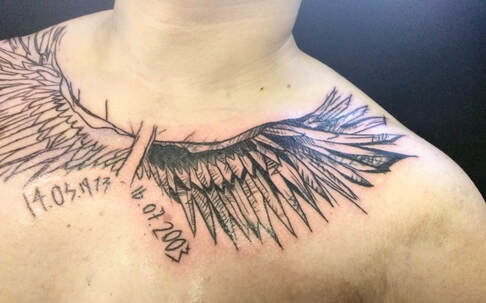
Kacpers tattoo at the point of completion of the first session.
Reflections and Considerations from Practice
When telling my colleagues of the experience the following day, they expressed that ‘days like that will happen’, and told me that I can make an excuse ask them to come to the room in which I work to see if they are able to help in any way. They had recognised the desire to not reveal any insecurity to a client to maintain a demeanour of professionalism and not worry the client, and acknowledged that this is part of the experience of the role of a tattooist. They also consoled me by explaining that the chest is an area that many have struggled with until they have over 7 years of experience, and that often in situations like the one I described, the tattoo is better than the practitioner thinks it is.
I showed my colleagues a photo of Kacpers tattoo at the point we got to, and they told me they thought it worked well and was a good piece. I trusted their sincerity, and was appreciative to be part of such a community of practice. We then went on to discuss how there is a void in the acknowledgement of these aspects of tattooing as a professional creative industry in favour of the more glamorous representations of the medium. This conversation echoed the importance of recording such experiences, representing the insecurities, concerns, and uncertainties in a reflective and confessional manner, in order to gain an authentic understanding of what the past 3 years have taught me is a layered and complex practice.
When telling my colleagues of the experience the following day, they expressed that ‘days like that will happen’, and told me that I can make an excuse ask them to come to the room in which I work to see if they are able to help in any way. They had recognised the desire to not reveal any insecurity to a client to maintain a demeanour of professionalism and not worry the client, and acknowledged that this is part of the experience of the role of a tattooist. They also consoled me by explaining that the chest is an area that many have struggled with until they have over 7 years of experience, and that often in situations like the one I described, the tattoo is better than the practitioner thinks it is.
I showed my colleagues a photo of Kacpers tattoo at the point we got to, and they told me they thought it worked well and was a good piece. I trusted their sincerity, and was appreciative to be part of such a community of practice. We then went on to discuss how there is a void in the acknowledgement of these aspects of tattooing as a professional creative industry in favour of the more glamorous representations of the medium. This conversation echoed the importance of recording such experiences, representing the insecurities, concerns, and uncertainties in a reflective and confessional manner, in order to gain an authentic understanding of what the past 3 years have taught me is a layered and complex practice.
Adam McDade
Tattooist at Triplesix Studios
AHRC NPIF Funded PhD Research Student at The University of Sunderland
 RSS Feed
